Benefits of Commercial Architectural Rendering: Complete Guide for Architects, Developers & Real Estate Professionals
Commercial architectural rendering has become an essential component in modern architecture, real estate, and construction, where traditional blueprints often fail to communicate complex design intent. Stakeholders frequently struggle to fully visualize commercial projects, leading to miscommunication, delayed decision-making, and costly revisions during the design process.
As a solution, commercial architectural rendering leverages advanced 3D visualization and photorealistic visualization techniques to transform concepts into clear, immersive digital representations. It serves not only as a visualization tool, but also as a decision-making enabler and a powerful asset for real estate marketing and project presentation.
By using professional rendering services, architects, developers, designers, and real estate professionals can improve communication, enhance design accuracy, reduce costs, and accelerate approvals. This guide explores the benefits of commercial architectural rendering, its workflow, ROI, and the tools and technologies behind it, helping stakeholders make informed decisions and choose the right rendering services for their projects.
What is Commercial Architectural Rendering?
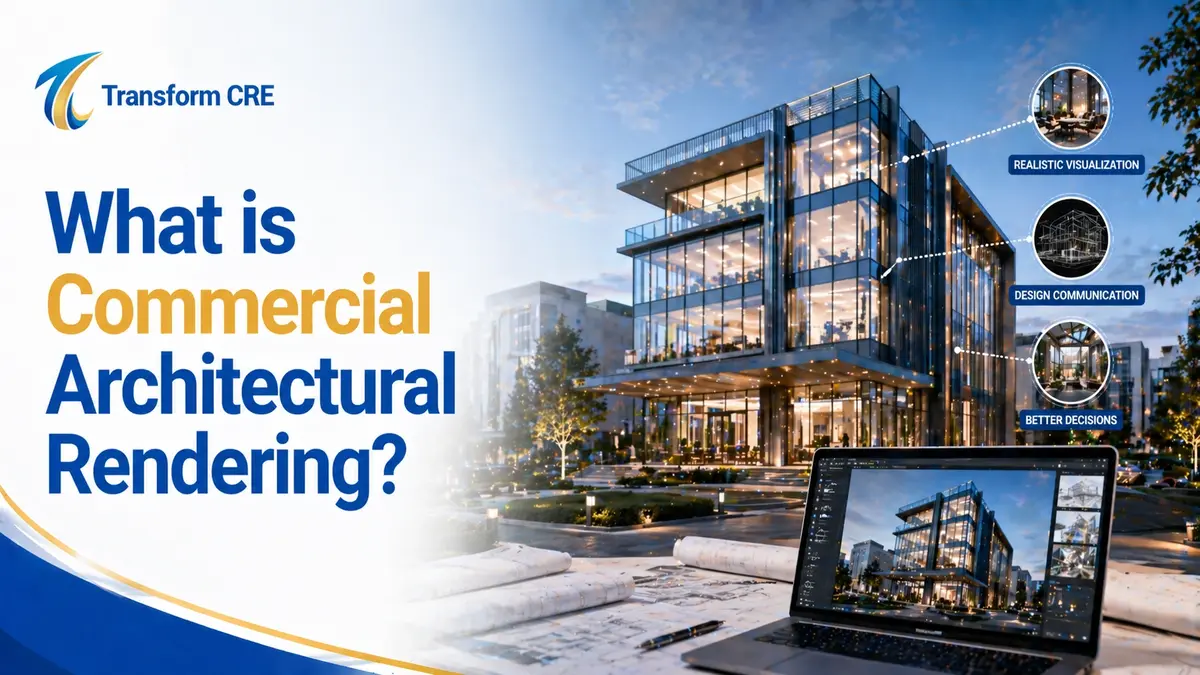
Commercial architectural rendering is a digital process that uses 3D visualization to create realistic, data-driven representations of commercial projects before construction begins. It enables architects, developers, and other stakeholders to transform design concepts into clear and immersive visuals, improving how commercial projects are understood and evaluated.
This industry-standard process involves multiple components, including 3D modeling, texturing and materials, lighting simulation, and environmental integration. Using advanced visualization technology and rendering software, professionals can produce high-quality, photorealistic rendering outputs that accurately depict building design, materials, and surroundings.
Commercial architectural rendering can take several forms, such as 2D rendering for basic layouts, 3D rendering for depth and realism, photorealistic rendering for high accuracy, and real-time rendering for interactive experiences. Tools like V-Ray, Lumion, and Unreal Engine support these formats and enable both static and interactive outputs.
In commercial projects, rendering is used to visualize designs before construction, support decision-making, improve communication between stakeholders, and enhance marketing presentations for real estate projects. Unlike traditional 2D drawings, blueprints, or physical models, modern rendering offers immersive visualization, faster revisions, and greater flexibility, especially with innovations like cloud-based visualization and interactive walkthroughs.
How Commercial Architectural Rendering Works (Process Breakdown)
Commercial architectural rendering follows an advanced rendering pipeline that transforms design concepts into high-quality, photorealistic visualizations through a structured, multi-stage digital workflow. This industry-standard workflow emphasizes precision, efficiency, and iterative refinement, ensuring that every stage of the rendering process contributes to accurate and compelling project visualization.
1. Concept Development & Data Collection
The process begins by gathering architectural plans, CAD drawings, sketches, and client requirements. This stage defines the design concept and project scope, ensuring alignment among stakeholders and establishing a clear foundation for the rendering workflow.
2. 3D Modeling (Structure Creation)
Using 3D modeling software such as AutoCAD, SketchUp, and Revit, designers build the digital structure of the project. This step defines dimensions, geometry, and spatial relationships, resulting in an accurate base model for commercial architectural rendering.
3. Texturing & Material Mapping
At this stage, realistic materials such as wood, glass, concrete, and metal are applied to the model. Through material mapping and surface detailing, designers enhance visual realism and achieve high accuracy photorealistic rendering.
4. Lighting Setup & Environmental Simulation
Lighting plays a critical role in architectural visualization. Professionals simulate natural lighting (sun position, time of day) and artificial lighting (fixtures, intensity) while integrating environmental context such as landscapes and surroundings. This ensures realistic lighting behavior and atmosphere.
5. Rendering (Image Generation)
Rendering engines like V-Ray, Lumion, and Corona Renderer process the scene into high-quality images, animations, and 3D visuals. Traditional rendering focuses on static outputs, while real-time visualization using Unreal Engine enables interactive experiences and faster iteration.
6. Post-Production & Final Output
In the final stage, visuals are refined through color correction, contrast adjustments, and visual effects. Outputs are delivered as images, animations, or walkthroughs, ready for presentations, marketing materials, or stakeholder review.
Modern Enhancements in Rendering Workflows
Today’s rendering workflows are enhanced by:
Real-time rendering engines for faster feedback
Cloud rendering platforms for scalable processing
GPU acceleration for fast turnaround
Collaborative workflows with remote access and live updates
These innovations support workflow optimization, real-time visualization, and cloud-based rendering, making commercial architectural rendering more efficient, scalable, and responsive for modern commercial projects.
Key Benefits of Commercial Architectural Rendering
Commercial architectural rendering has evolved into a multi-dimensional solution that enhances efficiency, improves visualization clarity, and delivers measurable business impact across commercial projects. By combining 3D rendering, architectural visualization, and advanced rendering workflow optimization, it enables architects, developers, and stakeholders to make informed decisions, streamline collaboration, and strengthen real estate marketing strategies. Below are the most impactful benefits of commercial architectural rendering.
1. Photorealistic Visualization for Better Decision-Making
One of the most significant benefits of commercial architectural rendering is its ability to produce photorealistic visualization with detailed textures, accurate lighting, and realistic materials. These high-quality, vivid, and immersive 3D visuals allow stakeholders to visualize the final product before construction begins, improving design validation and reducing uncertainty.
By using high accuracy photorealistic rendering, architects and developers can analyze, refine, and validate design choices, leading to faster and more confident decision-making. This level of visual clarity and precision ensures that every detail aligns with project expectations.
2. Improved Client Communication & Stakeholder Alignment
Commercial architectural rendering significantly enhances client communication and stakeholder collaboration by replacing abstract technical drawings with clear, interactive visualization. It helps architects, developers, contractors, and clients communicate ideas effectively, ensuring alignment throughout the design process.
With architectural design presentation tools and interactive 3D visualization for clients, teams can illustrate, present, and explain complex concepts in a visually compelling way. This reduces misunderstandings, improves feedback quality, and ensures smoother project execution.
3. Faster Design Revisions & Workflow Efficiency
Rendering enables fast rendering turnaround and seamless design revisions, allowing professionals to modify, adjust, and optimize designs quickly. Unlike traditional methods, digital rendering supports real-time updates and iterative refinement, improving responsiveness.
Through rendering workflow optimization and scalable architectural rendering solutions, teams can reduce turnaround time, enhance productivity, and streamline the overall design process. This leads to efficient project delivery and improved operational performance.
4. Cost Reduction & Risk Mitigation
Commercial architectural rendering helps reduce costs by eliminating the need for physical prototypes and repetitive rework. By identifying design issues early through 3D visualization and simulation, teams can prevent costly construction errors and delays.
This proactive approach enables stakeholders to analyze risks, optimize resources, and improve cost efficiency, making rendering a strategic and cost-effective investment for commercial projects.
5. Accurate Lighting, Materials & Environmental Simulation
Advanced rendering technologies allow for precise lighting analysis, material representation, and environmental integration. Designers can simulate natural and artificial lighting conditions, ensuring that spaces are both functional and visually appealing.
This level of detail enhances architectural design accuracy, improves planning, and supports better energy efficiency. By using advanced architectural rendering techniques, professionals can create realistic and data-driven visualizations that reflect real-world conditions.
6. Enhanced Real Estate Marketing & Pre-Sales
In competitive real estate markets, commercial architectural renderings and real estate visualization serve as powerful marketing tools. High-quality images, 3D commercial renderings, and virtual models enable developers to showcase properties before completion.
These visually appealing and compelling marketing materials help attract potential buyers, increase engagement, and support pre-construction sales and higher conversion rates. Rendering transforms marketing strategies by making projects more tangible and engaging.
7. Increased Client Confidence & Approval Rates
Clear and detailed visualizations help clients understand project outcomes with confidence, reducing uncertainty and hesitation. By providing a realistic preview of commercial projects, rendering enables stakeholders to validate decisions and approve designs faster.
This leads to improved client satisfaction, stronger trust, and fewer late-stage modifications, ultimately enhancing the overall project lifecycle.
8. Scalable Collaboration with Cloud-Based Rendering
Modern rendering workflows leverage cloud-based rendering for architects, enabling seamless digital collaboration across teams and locations. Stakeholders can access, review, and provide feedback in real time, improving communication and efficiency.
With scalable architectural rendering solutions and collaborative platforms, teams can handle projects of varying complexity while maintaining flexibility, responsiveness, and workflow efficiency.
9. Competitive Advantage in Commercial Projects
Using industry-leading architectural rendering services, firms can create professional, visually compelling presentations that stand out in competitive markets. Rendering helps developers and architects showcase, present, and differentiate their projects, increasing their chances of winning bids.
By leveraging expert commercial architectural rendering and advanced visualization technologies, businesses can strengthen their market position and attract more opportunities.
10. Interactive & Immersive Client Experiences (VR/AR)
Emerging technologies such as VR/AR and interactive visualization are transforming architectural presentation. These tools allow clients to explore immersive environments, interact with designs, and experience spaces virtually.
By integrating interactive 3D visualization and real-time architectural visualization, professionals can engage stakeholders more effectively, improve understanding, and deliver innovative, future-ready experiences.
Common Challenges & Limitations (And Solutions)
Despite its advantages, commercial architectural rendering presents several technical and operational challenges that professionals must address to maximize project efficiency, accuracy, and workflow performance. Understanding these limitations—and applying the right solutions—helps architects, developers, and stakeholders fully leverage architectural visualization tools and rendering technologies.
1. High Initial Cost → Budget Constraints → Scalable Solutions
Professional rendering services and rendering software can require significant investment, especially for smaller firms. This can limit adoption in early-stage projects.
Solution: Outsourcing to trusted rendering service providers, adopting scalable pricing models, and leveraging cloud rendering platforms can reduce infrastructure costs while maintaining high-quality outputs.
2. Time-Intensive Rendering Process → Delays → Workflow Optimization
High-quality photorealistic visualization and 3D rendering can be time-consuming, potentially slowing decision-making and project timelines.
Solution: Use real-time visualization tools such as Unreal Engine, GPU rendering, and rendering workflow optimization techniques to accelerate production and improve turnaround time.
3. Software Complexity & Skill Requirements → Learning Curve → Expertise Development
Advanced architectural visualization software often requires specialized skills, creating dependency on experts and slowing internal adoption.
Solution: Hire experienced professionals, invest in training, and adopt user-friendly, professional architectural visualization services to streamline operations.
4. Hardware Limitations → Performance Issues → Cloud-Based Infrastructure
Rendering large-scale commercial projects demands high-performance systems, increasing operational costs and limiting scalability.
Solution: Utilize cloud-based rendering and scalable computing environments, enabling remote processing and improving performance without heavy hardware investment.
5. Over-Reliance on Visualization → Design Imbalance → Technical Validation
Focusing too heavily on visual appeal can lead to decisions that prioritize aesthetics over functionality.
Solution: Combine rendering with technical validation and engineering analysis to maintain a balance between design quality and practical performance.
6. File Size & Data Management Issues → Collaboration Gaps → Optimized Workflows
Large rendering files can hinder sharing, slow collaboration, and create inefficiencies in the rendering workflow.
Solution: Implement cloud storage, file compression, and version control systems to enable seamless collaboration and efficient data management.
Modern Solutions Enhancing Rendering Efficiency
Emerging technologies continue to address these challenges through:
Cloud-based rendering for scalable and flexible workflows
Real-time architectural visualization for faster feedback
Collaborative platforms enabling global teamwork
GPU rendering for improved speed and efficiency
By addressing these limitations with advanced tools, optimized workflows, and strategic implementation, professionals can enhance project efficiency, reduce risks, and fully optimize the value of commercial architectural rendering in modern commercial projects.
How to Choose the Commercial Architectural Rendering Service
Choosing the right commercial architectural rendering service is a critical decision that directly impacts project success, cost efficiency, and visual quality. The right partner can enhance how your project is visualized, communicated, and marketed, while the wrong choice can lead to delays, misalignment, and subpar results. For architects, developers, and real estate professionals, selecting a reliable provider requires careful evaluation of both technical capabilities and workflow efficiency.
1. Portfolio Quality & Visual Realism
Start by reviewing the provider’s portfolio. Look for photorealistic rendering, high-quality images, accurate lighting, and detailed material representation. A strong portfolio reflects expertise, design accuracy, and the ability to deliver visually compelling results.
2. Industry Experience & Specialization
Choose providers with proven experience in commercial projects and real estate developments, such as office buildings, retail spaces, or hospitality projects. Industry-specific knowledge ensures better alignment with project requirements and improves overall outcomes.
3. Technology Stack & Tools
Evaluate the rendering tools and technologies used, including V-Ray, Lumion, and Unreal Engine. Providers offering real-time visualization, cloud-based rendering, and advanced architectural rendering technologies can deliver more efficient, scalable, and high-quality results.
4. Turnaround Time & Workflow Efficiency
Assess delivery timelines, revision cycles, and responsiveness. Providers with optimized project workflows and fast rendering turnaround can help maintain deadlines and improve project agility.
5. Pricing Structure & Cost Transparency
Understand pricing models, whether per image or per project. Transparent pricing ensures cost-effective solutions and avoids unexpected expenses, especially in large-scale commercial architectural renderings.
6. Communication & Collaboration Process
Effective client collaboration and communication are essential. Look for structured feedback loops, clear communication channels, and collaborative tools that support seamless interaction between stakeholders.
7. Client Reviews, Testimonials & Case Studies
Review client feedback and case studies to evaluate credibility. Proven success with real estate developers and commercial clients strengthens trust and demonstrates consistent performance.
8. Scalability & Flexibility
Ensure the provider can handle both small and large projects, multiple revisions, and evolving requirements. Scalable architectural rendering solutions support long-term collaboration and project growth.
9. Additional Services & Capabilities
Consider providers offering animations, virtual tours, VR/AR experiences, and interactive 3D visualization. These capabilities enhance project presentation and provide a competitive advantage in real estate marketing.
Questions to Ask Before Hiring
What rendering tools and technologies do you use?
What is your average turnaround time?
How many revisions are included in the process?
Can you share relevant case studies or past projects?
Do you offer real-time or interactive visualization solutions?